Introduction
Py-PDM is Aa Python wrapper of the Phase Dispersion Minimization (PDM), which is a C code written by Stellingwerf.
Compared with other Python implementations, with the help of Cython, we can obtain a much faster PDM tool.
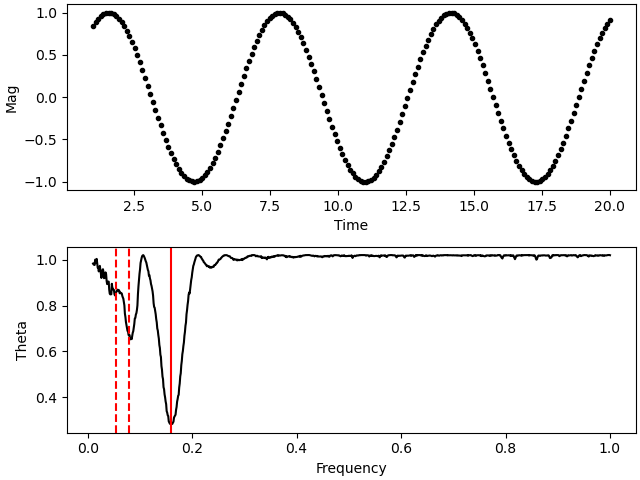
As an example, we can create a sinsoidal time series with period = \(2\pi\):
>>> import numpy
>>> t = np.linspace(0, 20, 101)
>>> y = np.sin(t)
Then we can calculate the PDM with Py-PDM
>>> from pdmpy import pdm
>>> freq, theta = pdm(t, y, f_min=0.01, f_max=1, delf=1e-3)
>>> print(f'Period is {1 / freq[np.argmin(theta)]:.3f}')
# Period is 6.289
We can also plot the freq vs theta to find the minima.
>>> import matplotlib.pyplot as plt
>>> fig, (ax1, ax2) = plt.subplots(2, 1, constrained_layout=True)
>>> ax1.plot(t, y, 'k.')
>>> ax1.set_xlabel('Time')
>>> ax1.set_ylabel('Mag')
>>> ax2.plot(freq, theta, 'k')
>>> ax2.axvline(1/2/np.pi, color='red')
>>> for i in range(2,4):
>>>     ax2.axvline(1/2/i/np.pi, color='red', ls='--')
>>> ax2.set_xlabel('Frequency')
>>> ax2.set_ylabel('Theta')